
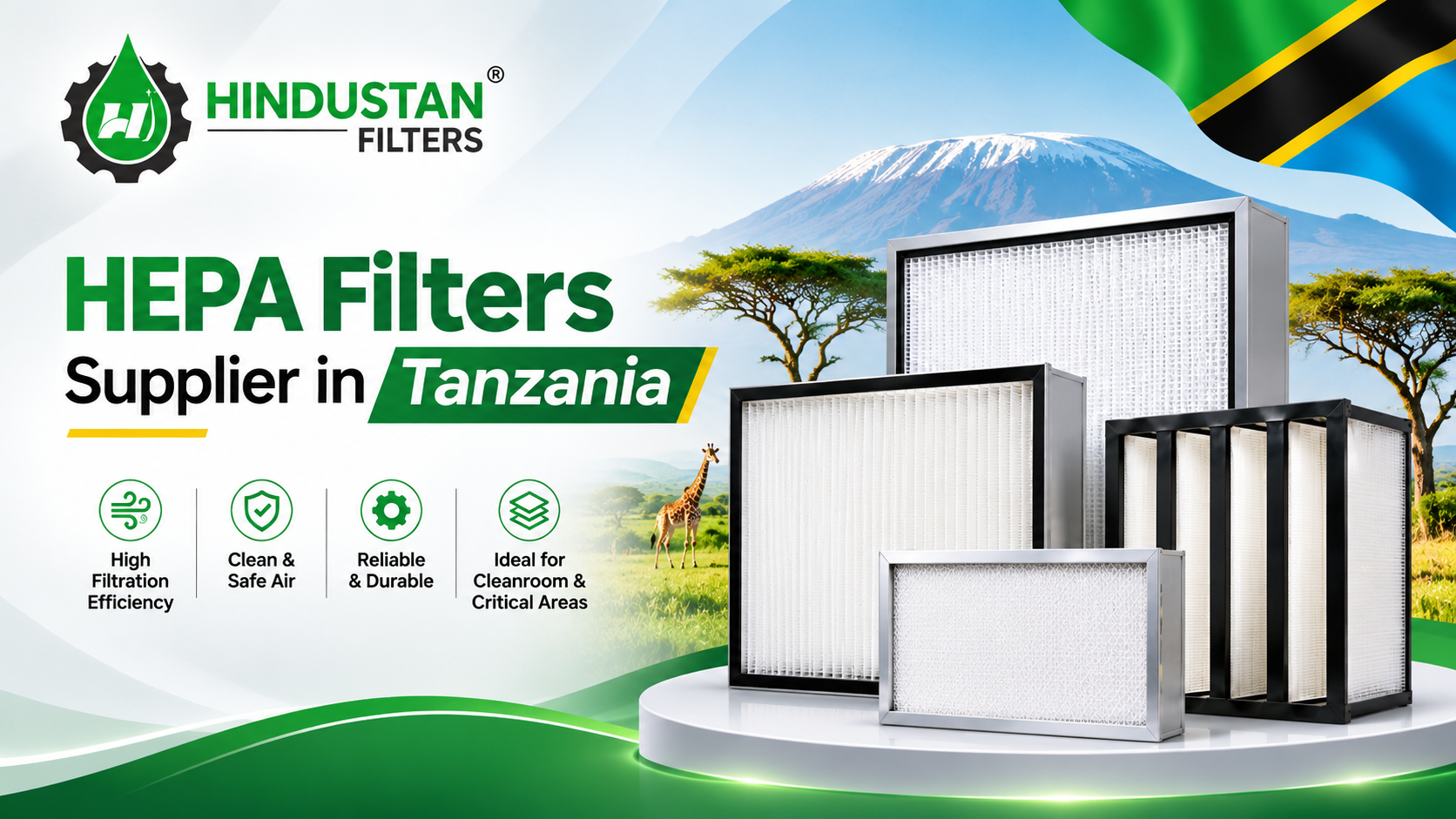
HEPA Filters Supplier in Tanzania – H13/H14 for Cleanrooms & AHUs
Quick answer: If you are looking for a HEPA filters supplier in Tanzania for a hospital, pharmaceutical cleanroom or industrial air handling unit (AHU), specify the required filter class, actual airflow and housing dimensions before requesting a price. In Tanzania, seasonal road dust, industrial airborne particles and humid coastal air can place different demands on an HVAC system. Pre-filters, corrosion suitability and seal compatibility therefore matter alongside H13 or H14 efficiency. Hindustan Filters can review Tanzania-bound technical enquiries using drawings, filter labels and project requirements. Ask for model-specific details and written confirmation of product availability, documentation and delivery terms; this page does not claim a local Tanzania office or warehouse.
What is an H13 or H14 HEPA filter? HEPA means High-Efficiency Particulate Air. It captures airborne particles rather than removing gases or odours. In EN 1822, H13 filters have at least 99.95% overall efficiency and H14 at least 99.995% at the most penetrating particle size (MPPS). ISO 29463 provides related classification and test methods. These are standard class thresholds, not proof that a particular Hindustan Filters model has passed testing. Ask for evidence tied to the actual filter offered.
HEPA Filter Specifications for Tanzania: Grade, Airflow, Resistance & Fit
Start with the duty point: The correct HEPA element matches the required filter grade, design airflow, initial resistance, housing dimensions and sealing arrangement. For cleanrooms, confirm the room specification and installed-filter integrity-testing plan; for AHUs, confirm that the fan can handle the filter bank resistance. An H14 label does not correct a poorly fitting frame or an undersized fan.
For a replacement in Dar es Salaam, Dodoma, Arusha, Mwanza or Mbeya, photograph the old label and measure the actual width, height and depth. Some installations use nominal 24 × 24 × 12 inch deep-pleat filters; others require compact mini-pleat panels or custom frames. Confirm dimensions in millimetres as well as inches, the gasket location, airflow direction and the clear housing opening. A filter can look identical from the front and still allow air to bypass around the seal.
📌 HEPA Filter RFQ Checklist for Tanzania Buyers:
- Filter Class: State the required H13, H14 or project-specified classification.
- Exact Size: Share width × height × depth in mm or inches; avoid relying only on a nominal size.
- Rated Airflow: State design airflow in m³/h or CFM and the number of filters sharing that duty.
- Pressure Drop: Request initial resistance in Pa at your airflow; verify the fan’s available static pressure.
- Frame: Specify the required construction material according to the installation.
- Media / Pleat Design: Specify deep-pleat or mini-pleat, plus the upstream pre-filter arrangement for dusty sites.
- Seal: Confirm gasket position, gasket type or gel-seal requirement.
- Testing / Documentation: Ask for applicable EN 1822 / ISO 29463 class evidence and individual-test records if required; confirm these are available for the proposed model.
Where HEPA Filters Are Used in Tanzania: Cleanrooms, Healthcare & HVAC
- Pharmaceutical and sterile-processing areas where the validated room design requires terminal HEPA filters
- Hospital isolation and critical ventilation systems where HEPA is part of the engineered airflow design
- Controlled manufacturing and packaging rooms with documented air-cleanliness requirements
- Laminar airflow equipment, laboratory enclosures and compatible clean benches
- Selected food processing and packaging zones requiring particulate control
- Electronics and precision assembly areas where airborne particles can affect processes
- Industrial AHUs and selected commercial HVAC systems with an appropriate pre-filter train
💡 Tanzania Site Note: Conditions Change the Filter Specification
How can facilities in Tanzania manage dust and humidity? Start at the outdoor air intake. During dry periods, road dust and nearby construction can increase pre-filter loading. At humid coastal sites such as Dar es Salaam, inspect the housing for condensation, moisture ingress and corrosion. After unusually dusty operating periods, check the pre-filter pressure drop before assuming the HEPA stage needs replacement. Suitable coarse and fine pre-filters can protect a downstream HEPA stage, but they must be selected for the system. Track filter differential pressure and inspect sealing rather than guessing a replacement date. Also confirm media, frame, adhesive and gasket suitability for the actual temperature and moisture conditions—not just the H13/H14 class printed on a label.
HEPA Filter Types for Tanzania: Deep-Pleat, Mini-Pleat & Seal Options
Which HEPA filter type should you buy? Choose the construction that matches the housing, available depth and airflow. Two H13 filters can have different resistance and sealing arrangements. The following are design options to discuss, not a confirmed stock list:
1. Deep Pleat HEPA Filters (24 x 24 x 12 Inch)
Deep-pleat construction can suit AHUs designed for a deeper filter bank. “24 × 24 × 12 inch” is only a nominal size example. Confirm actual frame size, separator details, airflow direction and available sealing clearance.
2. Mini Pleat HEPA Filters
Mini-pleat filters can offer high media area within a shallower assembly and may suit terminal or space-limited housings. Compare pressure drop at the same rated airflow, not a convenient lower test flow.
3. High-Temperature HEPA Filters
Use a high-temperature design only where the process needs it. Specify the continuous and peak air temperatures at the filter location—not merely the outdoor weather. Media, adhesive and gaskets each need suitable ratings, which must be verified for the quoted model.
4. Gel Seal & Custom Size HEPA Filters
A gel-seal terminal housing needs a matching knife-edge and gel channel. For nonstandard AHU installations in Tanzania, include a drawing and a close-up of the sealing face. A panel with the same outside dimensions may still be incompatible.
HEPA Filter Price in Tanzania: Buying Tips and Common Mistakes
- ✅ Compare identical specifications – Match grade, size, quantity, frame, gasket and test documentation. A low unit price may exclude required testing or freight.
- ✅ Compare actual airflow – Request pressure-drop figures at the project duty point, in the same units.
- ✅ Check sealing details – A wrong gasket face or gel channel can cause bypass and costly site rework.
- ✅ Review pre-filter maintenance – Include pre-filter stages, access for replacement and differential-pressure monitoring in the system plan.
- ✅ Specify the test evidence – Classification, individual filter test results and on-site installed-leak testing are distinct requirements. Do not treat a generic certificate as proof for every filter.
- ✅ Clarify Tanzania delivery scope – Ask whether the quote covers dispatch, freight, packing, insurance, destination and documents. Confirm Incoterms, customs arrangements and any applicable charges with the importer or freight partner; avoid assuming an all-inclusive delivered price.
HEPA Filter Applications in Tanzania: Requirements by Industry
- 🏥 Hospitals: isolation, operating or critical areas only where the ventilation design requires HEPA
- 💊 Pharmaceuticals: controlled production rooms and appropriately validated cleanroom systems
- 🧪 Laboratories: clean benches, pass boxes and terminal filter housings built for the filter
- 🍎 Food processing: selected handling and packing areas with specified particulate control
- 🌬️ Industrial AHUs: final filtration downstream of correctly selected pre-filter stages
- 💻 Electronics: clean assembly and sensitive manufacturing spaces
- 🏢 Research: facilities where the approved airflow and contamination-control plan calls for HEPA
HEPA Filter RFQ: What to Send Hindustan Filters from Tanzania
- 📐 Exact dimensions – Width × height × depth, units and a clear photo of the frame.
- 🌬️ Airflow data – Rated airflow, allowable initial pressure drop and pre-filter arrangement.
- 🛠️ Construction details – Frame, pleat design, gasket face or gel-seal interface and airflow direction.
- 📄 Project requirement – EN 1822 H13/H14 class or another approved class, and required test records.
- 📷 Site and delivery – Existing label, housing photo, quantity, delivery city and target date.
🇹🇿 HEPA Filter Enquiries for Dar es Salaam, Dodoma, Arusha & Other Tanzania Sites
For H13/H14 cleanroom filters or AHU replacement filters requested for Dar es Salaam, Dodoma, Arusha, Mwanza, Mbeya and other locations in Tanzania, include the destination, quantity, drawings and required delivery window. Confirm the required import documents, Incoterms and responsibilities with the buyer and freight partner. Location references do not mean Hindustan Filters maintains an office or warehouse in Tanzania.
Practical technical note: Before ordering a replacement, check which side the gasket sits on. A matching filter size is not enough if air can escape around the frame.
Frequently Asked Questions (FAQs) – HEPA Filters Supplier in Tanzania
What should a buyer in Tanzania include in a HEPA filter RFQ?
Send actual dimensions in mm, quantity, H13/H14 class, rated airflow, acceptable initial pressure drop, frame and gasket details, required test records and the delivery city. Include a photo of the existing filter label.
What is the difference between an H13 and H14 HEPA filter?
Quick answer: Under EN 1822, H13 has at least 99.95% overall efficiency at MPPS and H14 has at least 99.995%. Select the class specified by the design; a higher class does not fix housing leaks.
How can facilities in Tanzania protect HEPA filters from dust and humidity?
Use suitable coarse and fine pre-filters to reduce dust loading on the HEPA stage. Monitor differential pressure during dusty periods and check for condensation or moisture ingress, especially at humid coastal sites.
Why compare HEPA pressure drop at the same rated airflow?
Quick answer: Pressure drop is the resistance across the filter at a specified airflow. A lower resistance measured at a lower flow is not a fair comparison and may conceal fan-capacity issues.
Does fitting an H14 HEPA filter certify an ISO-classified cleanroom?
No. Cleanroom classification depends on the complete room and its measured particle concentration under the applicable ISO 14644 requirements; installed-filter integrity and airflow are also checked as required by the project.
What HEPA test documents should buyers in Tanzania request?
Ask for the applicable EN 1822 or ISO 29463 classification evidence and any specified individual filter test record. Installed-system leak testing is a separate site activity; confirm what the quoted model includes.
How can I match a replacement HEPA filter to an existing AHU?
Measure actual width, height and depth; photograph the old filter label, gasket face and housing. Add airflow direction and rated flow. Nominal dimensions alone cannot confirm a leak-tight replacement.
Can Hindustan Filters review a Tanzania-bound HEPA filter enquiry?
Contact Hindustan Filters to discuss Tanzania-bound cleanroom, hospital and industrial AHU requirements. Send quantities, specifications and destination, then request confirmation of available products, documentation, lead time and delivery terms.
Need HEPA Filters for a Cleanroom or AHU in Tanzania?
For a cleanroom, hospital ventilation system, laboratory or industrial AHU in Tanzania, an H13/H14 rating is only part of the choice. The filter also has to fit the housing, seal correctly and operate at the specified airflow and pressure drop. Send Hindustan Filters the filter schedule or existing label, measured dimensions, quantity, airflow, pre-filter details, seal type and delivery city. Ask for a written, model-specific response covering applicable test evidence, lead time, packaging and shipping terms. Contact the sales team with your Tanzania delivery location and required installation date. Confirm the gasket and frame drawing before approving the order.